

Sonia Delaunay: The Ukrainian-Born Artist Who Turned Colour into a European Language
She was born on the territory of today’s Ukraine, became one of the defining artists of the Parisian avant-garde, and proved that art does not have to live only inside museums. It can exist on fabric, in movement, in clothing, and in everyday life. Her story is not a simple story of successful migration. It is a story of how not to disappear in Europe, but to add your own rhythm to it.
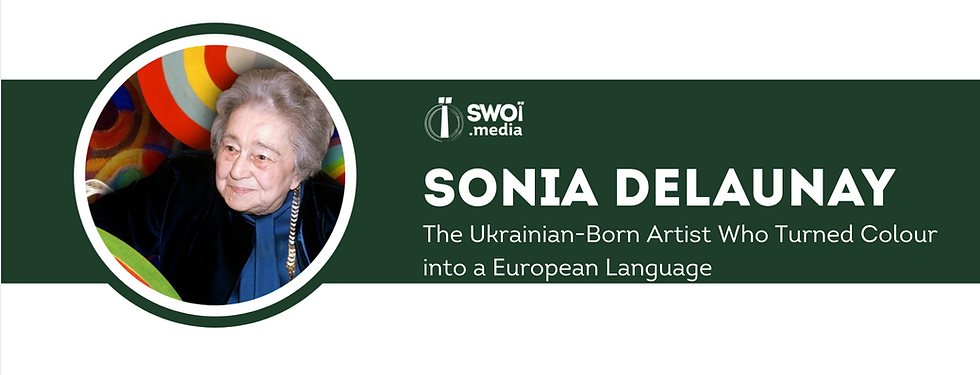
There are people who move to a new country and try to fit into its rules as neatly as possible.
And then there are people who arrive and quietly change the rules themselves.
Sonia Delaunay belonged to the second group.
She was born on the territory of today’s Ukraine, grew up between several cultures, studied in Germany, and found her most important artistic space in Paris. At the beginning of the 20th century, Paris was not simply a city of art. It was one of the places where the very idea of modernity was being defined.
Britannica lists Hradyzk, in today’s Ukraine and then part of the Russian Empire, as her birthplace. Other sources also mention Odesa as part of her biographical mythology. The safest and most accurate way to put it is this: Sonia Delaunay was born on the territory of today’s Ukraine and became one of the key figures of European modernism.
She is often described as a French artist. Formally, that is true: most of her life, work, and recognition were connected to France. But this description is too convenient. It erases something that matters, especially for us: her European identity was not a ready-made space she simply entered. She assembled it herself from a Ukrainian childhood, Jewish origin, Russian upbringing, a German art education, the Parisian avant-garde, and her own instinct for colour.
Her biography is not a story about “successful emigration”.
It is the story of a woman who refused to remain only a guest in someone else’s cultural space.
She became one of the people who shaped that space.
A girl moved into another world
Sonia Delaunay was born in 1885 as Sara or Sophia Stern. Her early biography has several versions and gaps, which is typical for people whose lives passed through empires, relocations, and changes of language.
As a child, she was taken in by her uncle’s family in Saint Petersburg. There, she received a different environment, different opportunities, and a new name: Sonia Terk.
This moment matters.

In stories about great people, we often look for a straight path: born, educated, became famous. But Sonia Delaunay’s path was not straight. From the very beginning, her life was a movement between worlds.
She did not have one stable context that explained everything.
She had to build herself from different parts.
There is something very contemporary in that.
Today, many Ukrainians in Europe experience something similar, although under completely different historical circumstances: previous experience exists, but the new space does not automatically know how to read it. Origin matters, but it does not explain a person completely. One’s language remains, but it is no longer the only tool. Identity does not disappear; it becomes more complex.
Sonia Delaunay walked this path long before we began calling it a “new reality”.
Paris: a place where you had to avoid disappearing
In 1905, Sonia moved to Paris. For a young artist, this was not simply a move to a beautiful city. It was an entrance into an environment that already had its names, salons, galleries, rules, and men who were very confident in explaining what art was.
She studied at the Académie de La Palette, but according to biographical sources, she spent more time in Parisian galleries studying the work of Van Gogh, Gauguin, Rousseau, Matisse, and other artists than in formal academic training.
That, too, is telling.

Strong people do not always grow where they are officially taught. Often, they grow where they find their own way of seeing.
Paris could have turned her into just another foreign woman on the edge of the art scene. But she did not remain an observer. She entered the avant-garde, became part of the School of Paris, worked alongside Robert Delaunay, and later became associated with Orphism, a movement in abstract art where colour, light, rhythm, and geometry became central.
Tate describes Sonia Delaunay, together with Robert Delaunay, as a co-founder of Orphism.
But if we reduce Sonia to “Robert Delaunay’s wife”, we repeat what history has so often done to women: place them next to a man and slightly to the side of their own power.
Her contribution was not decorative.
She did not simply complement the avant-garde.
She expanded the very idea of what art could be.
When a painting refuses to stay on the wall
Sonia Delaunay did not want art to remain inside a frame.
That may be the most modern thing about her work.
For many artists, a painting was the final form. For her, it was only one of many possible surfaces. She transferred colour onto textiles, dresses, furniture, books, stage sets, and interiors. Her practice included painting, illustration, textile design, fashion, scenography, and design.
Britannica calls her a pioneer of abstract art before the First World War. Tate highlights her work with colour, geometric forms, and different media.
This is where she feels especially relevant today.
We also live in a time when the boundaries between disciplines are dissolving. An artist can build a brand. A designer can think like an editor. An entrepreneur can become a curator of meanings. A media platform can be more than a website; it can become an environment.
Sonia Delaunay was doing this more than a hundred years ago.
She did not wait for someone to allow her to be a “serious artist” only on canvas. She made serious the things that had long been treated as applied, feminine, domestic, or decorative.
Fabric became art.A dress became art.Everyday life became art.Colour on the body became art, too.

It was a quiet, but radical gesture.
A Ukrainian quilt that helped shape modernism
One of the most beautiful episodes in Sonia Delaunay’s biography is connected to a quilt she made for her son.
In 1911, she created a patchwork quilt from pieces of coloured fabric. Later, she recalled that she had been inspired by the quilts she had seen in Ukrainian peasant homes. This object became an important turning point in her movement toward geometric abstraction and “simultaneous” art.
The moment is almost cinematic.
European modernism. Paris. The avant-garde. Great names.
And suddenly, at the centre of this story, there is the memory of a Ukrainian village quilt.
Not a museum object.Not a grand theory.Not an academic manifesto.
A quilt.
Something that could easily have been dismissed as “domestic”, “simple”, or “not really art” became the source of a new artistic language.
Here, it is important not to fall into a sweet patriotic narrative: as if everything great simply “comes from Ukraine”. That would be too easy.
Something else is stronger: Sonia Delaunay did not cut her origins off from her European future. She did not try to become a “purely French” artist without traces of a previous life. She took memory, form, rhythm, and colour, and translated them into a new context.
Not as folklore.
As modernism.
That is where her power lies.
A woman who refused to choose between art and business
In the 1920s, Sonia Delaunay developed her own fashion practice. She worked with textiles, clothing, private clients, stage costumes, and design. In 1925, her Boutique simultané was presented at the International Exhibition of Modern Decorative and Industrial Arts in Paris, the exhibition that gave Art Deco its name.
This is another underestimated layer of her story.
She was not an artist standing far away from “commerce” with the clean hands of a genius. She worked with the market. With clothing. With clients. With producers. With material reality.
And it did not make her smaller.
On the contrary.
Today, we understand well that cultural power is not visible only in museums. It also lives in what people wear, buy, see every day, and in how they shape the spaces around them. Sonia Delaunay understood this very early, and very intuitively.
She made colour not only an aesthetic choice, but a form of presence.
Imagine Paris in the 1920s.
Women in her dresses.Geometry on fabric.Colour moving with the body.Art not hanging on the wall, but walking down the street.
This was not fashion as a seasonal whim.
It was a new type of person who no longer wanted to be neutral in space.
Recognition that came, but not immediately
Sonia Delaunay lived a long life and eventually received major recognition. In 1964, she became the first living female artist to be given a retrospective at the Louvre. In 1975, she was awarded the French Legion of Honour.
But it is important to remember: biographies like this are not made of smooth upward movement.
Especially when you are a woman.Especially when you are a migrant.Especially when you work between “high” and “applied” art.Especially when your practice does not fit neatly into one convenient category.
Sonia Delaunay was not simply given a place in history.
She endured her way into it.
And perhaps this is the most important thing for our People section.
Because we are not interested only in success stories. Success often becomes flat when retold from the finish line. We are interested in how a person holds their line while they are still difficult to classify.
Sonia Delaunay was exactly that kind of person.
She was not “only an artist”.Not “only a designer”.Not “only the wife of an artist”.Not “only an emigrant with Ukrainian roots”.Not “only part of the Parisian avant-garde”.
She was a system of her own.
Why this story matters now
One might ask: why should a Ukrainian media platform in Europe write about Sonia Delaunay today?
Because her story speaks very precisely about what happens to people after displacement.
You can lose your old context.
But you do not have to lose your own way of seeing.
You can live in a new culture.
But you do not have to disappear into it without a trace.
You can work in the European market.
But your previous experience, memory, language, craft, childhood, and cultural code are not waste to be left at the entrance.
Sometimes, they become your advantage.
But only if you do not present them as a provincial detail.
Only if you know how to turn them into form, language, style, and decision.
Sonia Delaunay did not ask Europe to notice the Ukrainian quilt.
She turned its logic into a new visual world.
That may be the strongest form of integration:
not dissolving, but bringing something of your own so fully that the whole can no longer be imagined without it.
Not from zero. From colour.
Sonia Delaunay died in Paris in 1979. But her works still do not feel like archival material. They feel like energy: circles, rhythms, fabrics, dresses, contrasts, movement, light.
Her legacy lives because she was not afraid to take art out of the museum and into everyday life.
From our perspective, her story is not about how a Ukrainian became French.
It is about something else.
It is about a person who took several worlds and refused to let any one of them swallow her completely.
She did not begin from zero.
She began with memory, colour, movement, fabric, experience, a sharp eye, and a stubborn inner freedom.
And from that, she made a Europe that is still being quoted.
In den Geschichten großer Menschen suchen wir oft nach einem geraden Weg: geboren, gelernt, berühmt geworden. Doch Sonia Delaunays Weg war nicht gerade. Ihr Leben war von Anfang an eine Bewegung zwischen Welten.
Sie hatte keinen einzigen stabilen Kontext, der alles erklärte.
Sie musste sich aus verschiedenen Teilen zusammensetzen.
Darin liegt etwas sehr Gegenwärtiges.
Viele Ukrainerinnen und Ukrainer in Europa erleben heute etwas Ähnliches, wenn auch unter völlig anderen historischen Umständen: Die frühere Erfahrung ist da, aber der neue Raum kann sie nicht automatisch lesen. Die Herkunft bedeutet etwas, erklärt einen aber nicht vollständig. Die eigene Sprache bleibt, ist aber nicht mehr das einzige Werkzeug. Die Identität verschwindet nicht — sie wird komplexer.
Sonia Delaunay ging diesen Weg lange bevor wir begannen, ihn “neue Realität” zu nennen.

Comments